
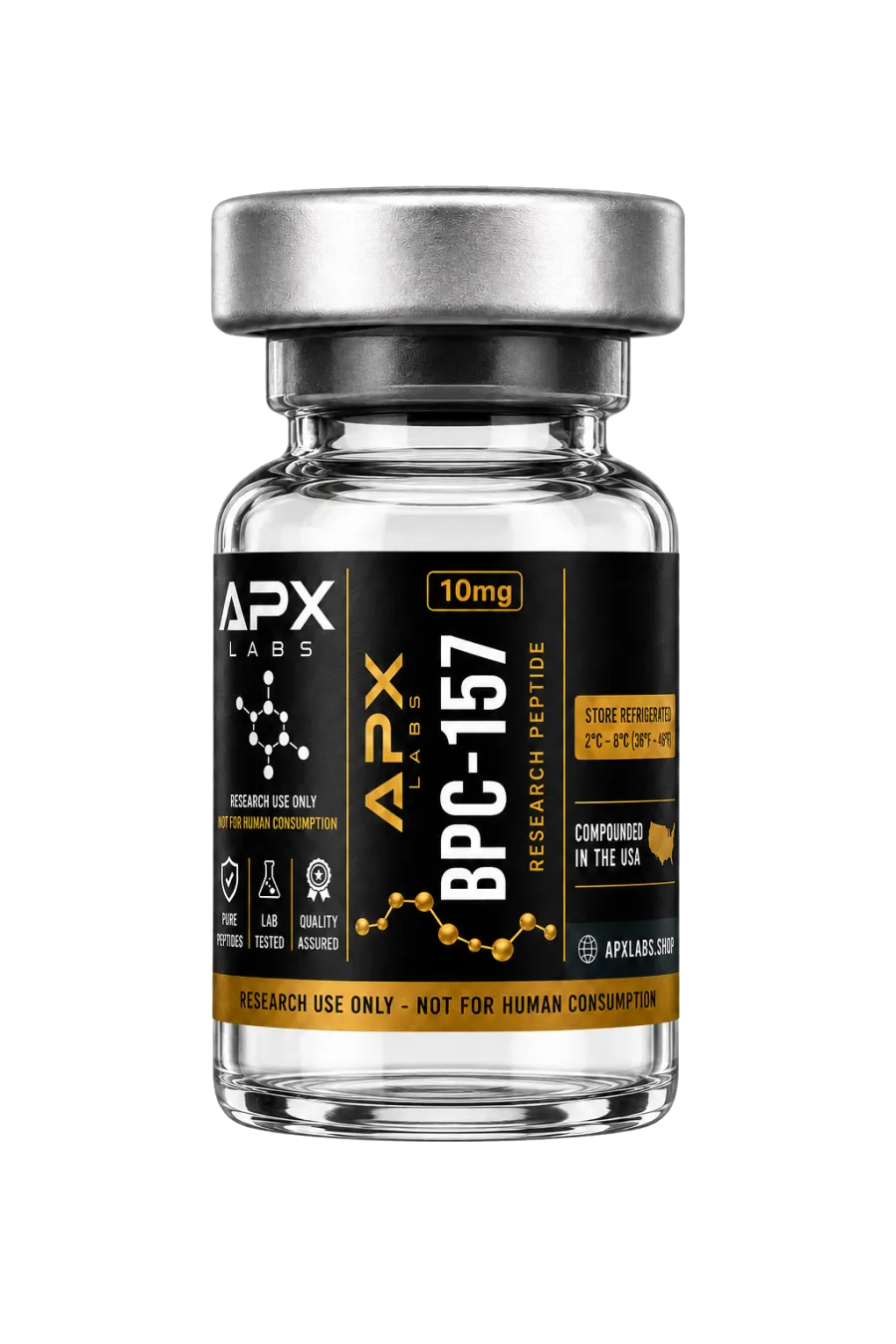
BPC-157
BPC-157 is a synthetic pentadecapeptide — 15 amino acids, C62H98N16O22, 1419.5 g/mol — whose sequence is derived from a protective protein found in gastric juice. In laboratory research it is studied for angiogenesis, tendon and ligament repair signalling, and gut-lining integrity. APX Labs supplies it as a 10 mg lyophilized vial, ≥99% purity by HPLC/MS, with a batch-specific COA. Research use only.
- Class: body-protection compound (BPC), synthetic pentadecapeptide
- Sequence: Gly-Glu-Pro-Pro-Pro-Gly-Lys-Pro-Ala-Asp-Asp-Ala-Gly-Leu-Val
- Research contexts in the literature: tendon and ligament repair, angiogenesis, gastrointestinal protection
- Format: 10 mg lyophilized vial — reconstitute with bacteriostatic water
- Documentation: independent HPLC/MS test, batch-specific COA in every order
- Research category
- Recovery & Repair
- Amino-acid sequence
- Gly-Glu-Pro-Pro-Pro-Gly-Lys-Pro-Ala-Asp-Asp-Ala-Gly-Leu-Val
- Formula / short form
- C62H98N16O22
- Molecular weight
- 1419.5 g/mol
- Quantity per vial
- 10 mg
- Purity
- ≥99% (HPLC/MS, per-lot COA)
- Test method
- HPLC / MS
- Form
- Lyophilized powder
- Documentation
- Batch-specific COA ships with every order
What is BPC-157?
BPC-157 (Body Protection Compound-157) is a synthetic peptide of 15 amino acids. Its sequence is a fragment of a larger protein isolated from human gastric juice, which is why much of the early literature comes from gastroenterology labs. Unlike many research peptides it is notably stable in acidic conditions, a property the originating research group has described in detail [1].
It is one of the most-requested compounds in the recovery category and a common entry point for laboratories building a tissue-repair research programme.
What is BPC-157 studied for in research?
The published animal and in-vitro literature on BPC-157 clusters around three themes:
- Tendon and ligament models. A frequently cited rat study reported that BPC-157 promoted tendon outgrowth, cell survival and migration in explant and fibroblast models [2]; a 2026 review collects the subsequent tendon, ligament and muscle-to-bone work [3].
- Angiogenesis and nitric-oxide pathways. The originating group has repeatedly framed the compound's studied effects around blood-vessel formation and NO-system modulation [4].
- Gastrointestinal protection. As a gastric-derived peptide, much of the literature concerns gut-lining models and organ-protection endpoints [5].
These are descriptions of what has been studied in laboratory settings. They are not claims of effect in humans, and APX Labs makes none.
BPC-157 vs TB-500
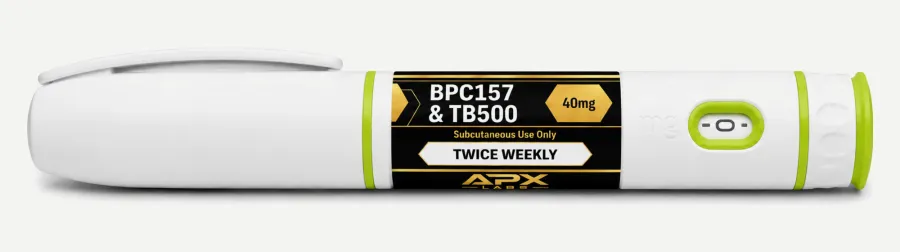
Researchers often evaluate BPC-157 alongside TB-500 because both appear in recovery-model literature. They are structurally unrelated: BPC-157 is a gastric-derived pentadecapeptide, TB-500 is a synthetic fragment of thymosin β4, an actin-binding protein. Read the full comparison in BPC-157 vs TB-500: what the research actually compares, or see the pre-blended BPC-157 & TB-500 research pen.
Specifications, purity and documentation
Every APX Labs lot of BPC-157 is sent to an independent laboratory for identity confirmation (mass spectrometry, matching the expected 1419.5 g/mol) and purity by HPLC. The batch-specific Certificate of Analysis ships in the box. How to read the COA →
BPC-157 — frequently asked
What is BPC-157?⌄
What is the difference between BPC-157 and TB-500?⌄
How is BPC-157 purity verified?⌄
How should BPC-157 be stored?⌄
Further reading
- BPC-157 vs TB-500: What the Research Actually Compares — The two most-requested recovery-category peptides are structurally unrelated and studied through different pathways. Here is the side-by-side, with sources.
- How to Read a Peptide Certificate of Analysis (COA) — Every APX Labs order ships with a batch-specific COA. This is how to read it — and how to tell a real one from a decorative one.
- How to Reconstitute Lyophilized Peptides for Laboratory Use — Lyophilized peptides arrive as a dry cake in a sealed vial. Turning that into a solution of known concentration is simple, but the details protect the material.
- How to Store Research Peptides: Lyophilized, Reconstituted and Pre-Filled — Peptides degrade by hydrolysis, oxidation and aggregation. Cold, dark and dry slow all three. The practical rules, by format.
- What HPLC/MS Purity Testing Actually Measures — Two techniques, two questions. HPLC asks how much; mass spectrometry asks what. A COA that answers only one is half a COA.
- Lyophilized Vial vs Pre-Filled Pen: Choosing a Research Format — Nine catalog compounds ship as vials, five as pens. The choice is about flexibility versus consistency, not quality.
References
Published research cited for context only. Citing a study does not imply APX Labs product was used in it, and is not a claim of any effect.
- Sikiric P, et al. (2025). Stable Gastric Pentadecapeptide BPC 157 as a Therapy and Safety Key: A Special Beneficial Pleiotropic Effect. Pharmaceuticals (Basel). PubMed ↗
- Chang CH, et al. (2011). The promoting effect of pentadecapeptide BPC 157 on tendon healing involves tendon outgrowth, cell survival, and cell migration. J Appl Physiol. PubMed ↗
- Sikiric P, et al. (2026). Tendon, Ligament, and Muscle Injury, Osteotendinous, Myotendinous, and Muscle-to-Bone Junction Therapy. Pharmaceuticals (Basel). PubMed ↗
- Sikiric P, et al. (2025). BPC 157 Therapy: Targeting Angiogenesis and Nitric Oxide's Cytotoxic and Damaging Actions. Pharmaceuticals (Basel). PubMed ↗
- Sikiric P, et al. (2025). Stable Gastric Pentadecapeptide BPC 157 as Therapy After Surgical Detachment of the Quadriceps Muscle. Pharmaceutics. PubMed ↗
What is BPC-157 studied for?
Widely referenced in recovery and gut-integrity research models for its studied effects on angiogenesis, tendon and ligament repair signalling, and tissue protection.
Reconstitution & storage
Ships lyophilized in a sealed vial. Store cold and away from light. Reconstitute with bacteriostatic water (not included); once reconstituted, keep refrigerated and use within the window documented on the COA.
Research use only
Sold strictly for laboratory and research purposes. Not for human or veterinary use, and not intended to diagnose, treat, cure, or prevent any disease. Not evaluated by the FDA. Read the policy → · What RUO means →
Ready to start your research?
Third-party tested. COA-backed. Shipped discreetly. For research use only.