
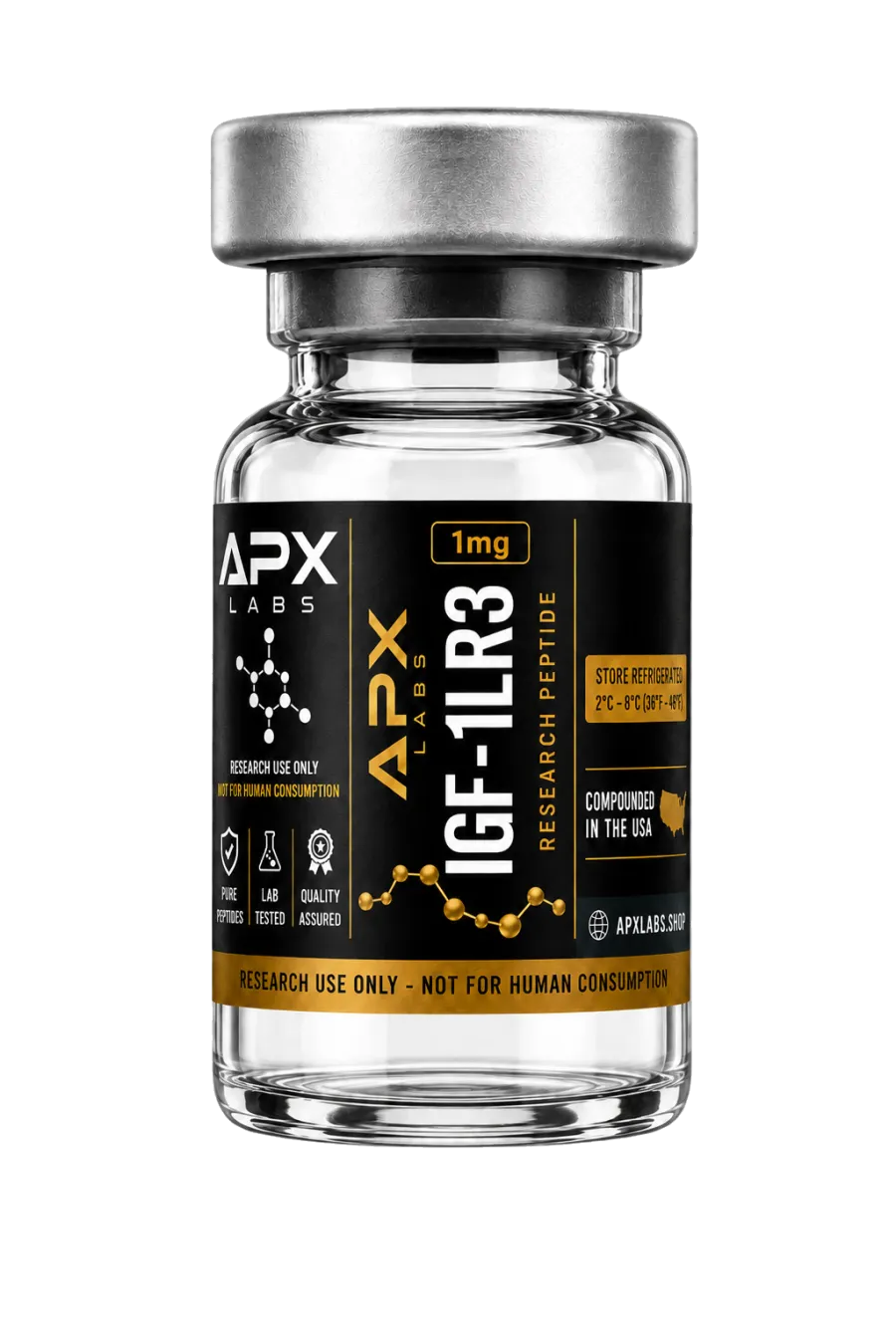
IGF-1 LR3
IGF-1 LR3 (Long R3 IGF-I) is an 83-amino-acid analog of insulin-like growth factor 1 — C400H625N111O115S9, 9111.5 g/mol — with a 13-residue N-terminal extension and an arginine substitution at position 3. Those changes sharply reduce its binding to IGF-binding proteins, which is why it is used in cell-culture and animal research where an unbound, long-acting IGF-1 signal is wanted. APX Labs supplies it as a 1 mg lyophilized vial, ≥99% purity by HPLC/MS, with a batch-specific COA. Research use only.
- Class: IGF-1 analog — N-terminal extension + Glu3→Arg substitution
- Formula: C400H625N111O115S9 · 9111.5 g/mol · 83 amino acids
- Research contexts in the literature: IGF-binding-protein-independent potency, anabolic models, cell-culture growth factor
- Format: 1 mg lyophilized vial — reconstitute with bacteriostatic water
- Documentation: independent HPLC/MS test, batch-specific COA in every order
- Research category
- Growth & Performance
- Formula / short form
- C400H625N111O115S9
- Molecular weight
- 9111.5 g/mol
- Quantity per vial
- 1 mg
- Purity
- ≥99% (HPLC/MS, per-lot COA)
- Test method
- HPLC / MS
- Form
- Lyophilized powder
- Documentation
- Batch-specific COA ships with every order
What is IGF-1 LR3?
Native IGF-1 circulates almost entirely bound to IGF-binding proteins (IGFBPs), which limits how much is free to act on receptors. Long R3 IGF-I was engineered in the 1990s to bind those proteins poorly: the 'Long' refers to a 13-residue extension at the N-terminus, the 'R3' to the arginine that replaces glutamate at position 3. The result is an analog widely used as a cell-culture growth-factor supplement and in animal physiology research.
What is IGF-1 LR3 studied for in research?
- Binding-protein-independent potency. Infusion studies compared IGF-I analogs that bind IGFBPs poorly and reported superior potency that was maintained over time [1].
- Catabolic and body-composition animal models. LR3 IGF-I has been studied in models of weight loss under catabolic stress [2] and for the timing of IGF-I administration in anti-catabolic protocols [3].
- IGF-1 signalling generally. Because IGF-1 acts on a receptor implicated in cell proliferation, its biology is also studied in oncology contexts [4] — a reason the compound is strictly a research reagent.
Laboratory and animal findings only — not claims of human effect.
Specifications, purity and documentation
Identity by mass spectrometry (expected ~9,111.5 g/mol), purity by HPLC, batch-specific COA in every order. A 1 mg vial is the standard research quantity for a protein of this size. How to read the COA →
IGF-1 LR3 — frequently asked
What is IGF-1 LR3?⌄
How is IGF-1 LR3 different from native IGF-1?⌄
Why is the vial only 1 mg?⌄
Further reading
- How to Reconstitute Lyophilized Peptides for Laboratory Use — Lyophilized peptides arrive as a dry cake in a sealed vial. Turning that into a solution of known concentration is simple, but the details protect the material.
References
Published research cited for context only. Citing a study does not imply APX Labs product was used in it, and is not a claim of any effect.
- Tomas FM, et al. (1996). Superior potency of infused IGF-I analogues which bind poorly to IGF-binding proteins is maintained when administered by injection. J Endocrinol. PubMed ↗
- Tomas FM, et al. (2001). Insulin-like growth factor-I (IGF-I) analogue, LR3IGF-I, ameliorates the loss of body weight. Growth Horm IGF Res. PubMed ↗
- Tomas FM, et al. (1998). The anti-catabolic efficacy of insulin-like growth factor-I is enhanced by its early administration. J Endocrinol. PubMed ↗
- Wetterau LA, et al. (2003). Insulin-like growth factor I stimulates telomerase activity in prostate cancer cells. J Clin Endocrinol Metab. PubMed ↗
What is IGF-1 LR3 studied for?
Referenced in cell-growth and metabolism research for its studied receptor affinity and extended half-life relative to native IGF-1.
Reconstitution & storage
Ships lyophilized in a sealed vial. Store cold and away from light. Reconstitute with bacteriostatic water (not included); once reconstituted, keep refrigerated and use within the window documented on the COA.
Research use only
Sold strictly for laboratory and research purposes. Not for human or veterinary use, and not intended to diagnose, treat, cure, or prevent any disease. Not evaluated by the FDA. Read the policy → · What RUO means →
Ready to start your research?
Third-party tested. COA-backed. Shipped discreetly. For research use only.