
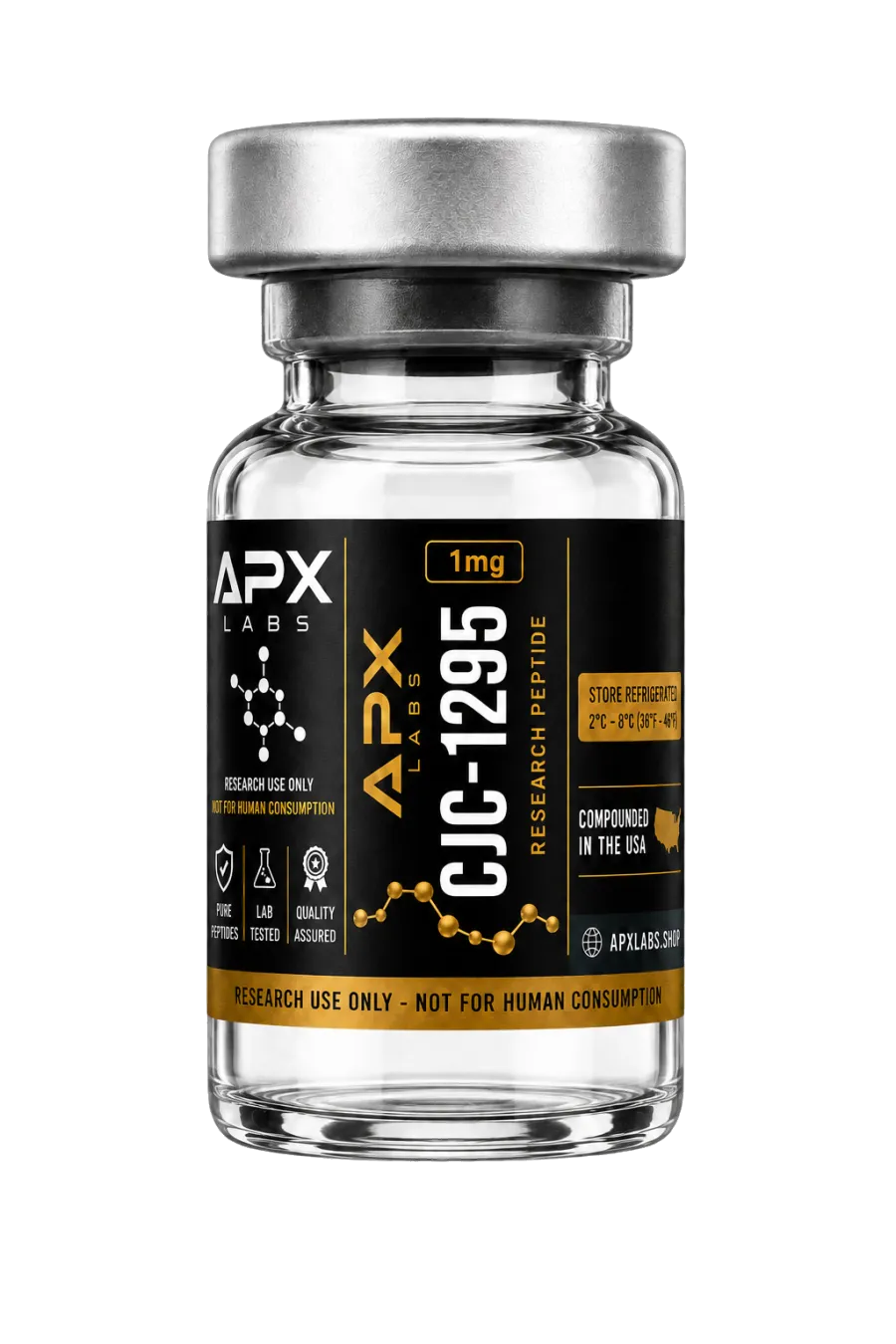
CJC-1295
CJC-1295 is a synthetic analog of growth-hormone-releasing hormone (GHRH 1-29) — C152H252N44O42, 3367.9 g/mol — with amino-acid substitutions designed to resist enzymatic breakdown. It is studied in endocrine research for its effect on growth-hormone and IGF-1 signalling. APX Labs supplies it as a 5 mg lyophilized vial, ≥99% purity by HPLC/MS, with a batch-specific COA. Research use only.
- Class: GHRH(1-29) analog, tetrasubstituted for stability
- Formula: C152H252N44O42 · 3367.9 g/mol
- Research contexts in the literature: GH and IGF-1 secretion, pulsatility of GH release
- Format: 5 mg lyophilized vial — reconstitute with bacteriostatic water
- Documentation: independent HPLC/MS test, batch-specific COA in every order
- Research category
- Growth & Performance
- Formula / short form
- C152H252N44O42
- Molecular weight
- 3367.9 g/mol
- Quantity per vial
- 5 mg
- Purity
- ≥99% (HPLC/MS, per-lot COA)
- Test method
- HPLC / MS
- Form
- Lyophilized powder
- Documentation
- Batch-specific COA ships with every order
What is CJC-1295?
Native GHRH is broken down within minutes by the enzyme DPP-IV. CJC-1295 is a modified 29-residue GHRH analog with four substitutions that protect it from that cleavage. The compound appears in the literature in two variants: the original, which carries a drug-affinity-complex (DAC) group that binds serum albumin, and the version without it, sometimes called 'Mod GRF 1-29'. The COA for your lot states which form was tested.
What is CJC-1295 studied for in research?
- GH and IGF-1 secretion. Two 2006 clinical-pharmacology papers in *J Clin Endocrinol Metab* characterised prolonged stimulation of GH and IGF-1 [1] and, notably, that GH secretion remained pulsatile during continuous stimulation [2] — the two most-cited references for the compound.
- GHRH-analog comparisons. It is frequently studied alongside tesamorelin, another stabilised GHRH analog; see GHRH analogs explained.
Laboratory and clinical-pharmacology findings only — APX Labs makes no claim of effect.
Specifications, purity and documentation
Identity by mass spectrometry, purity by HPLC, batch-specific COA in every order. How to read the COA →
CJC-1295 — frequently asked
What is CJC-1295?⌄
What is the difference between CJC-1295 with and without DAC?⌄
CJC-1295 vs tesamorelin?⌄
Further reading
- How to Read a Peptide Certificate of Analysis (COA) — Every APX Labs order ships with a batch-specific COA. This is how to read it — and how to tell a real one from a decorative one.
- How to Reconstitute Lyophilized Peptides for Laboratory Use — Lyophilized peptides arrive as a dry cake in a sealed vial. Turning that into a solution of known concentration is simple, but the details protect the material.
- What HPLC/MS Purity Testing Actually Measures — Two techniques, two questions. HPLC asks how much; mass spectrometry asks what. A COA that answers only one is half a COA.
- GHRH Analogs Explained: CJC-1295 vs Tesamorelin — Native growth-hormone-releasing hormone lasts minutes. Two very different engineering answers to that problem are in the APX Labs catalog.
References
Published research cited for context only. Citing a study does not imply APX Labs product was used in it, and is not a claim of any effect.
- Teichman SL, et al. (2006). Prolonged stimulation of growth hormone (GH) and insulin-like growth factor I secretion by CJC-1295, a long-acting analog of GH-releasing hormone. J Clin Endocrinol Metab. PubMed ↗
- Ionescu M, Frohman LA (2006). Pulsatile secretion of growth hormone (GH) persists during continuous stimulation by CJC-1295, a long-acting GH-releasing hormone analog. J Clin Endocrinol Metab. PubMed ↗
What is CJC-1295 studied for?
Investigated in endocrine research for its studied effect on growth-hormone release and downstream IGF-1 signalling in laboratory models.
Reconstitution & storage
Ships lyophilized in a sealed vial. Store cold and away from light. Reconstitute with bacteriostatic water (not included); once reconstituted, keep refrigerated and use within the window documented on the COA.
Research use only
Sold strictly for laboratory and research purposes. Not for human or veterinary use, and not intended to diagnose, treat, cure, or prevent any disease. Not evaluated by the FDA. Read the policy → · What RUO means →
Ready to start your research?
Third-party tested. COA-backed. Shipped discreetly. For research use only.