
GHRH Analogs Explained: CJC-1295 vs Tesamorelin
Native growth-hormone-releasing hormone lasts minutes. Two very different engineering answers to that problem are in the APX Labs catalog.
Published 2026-09-18 · APX Labs Research Desk · For laboratory research context only — not medical advice.
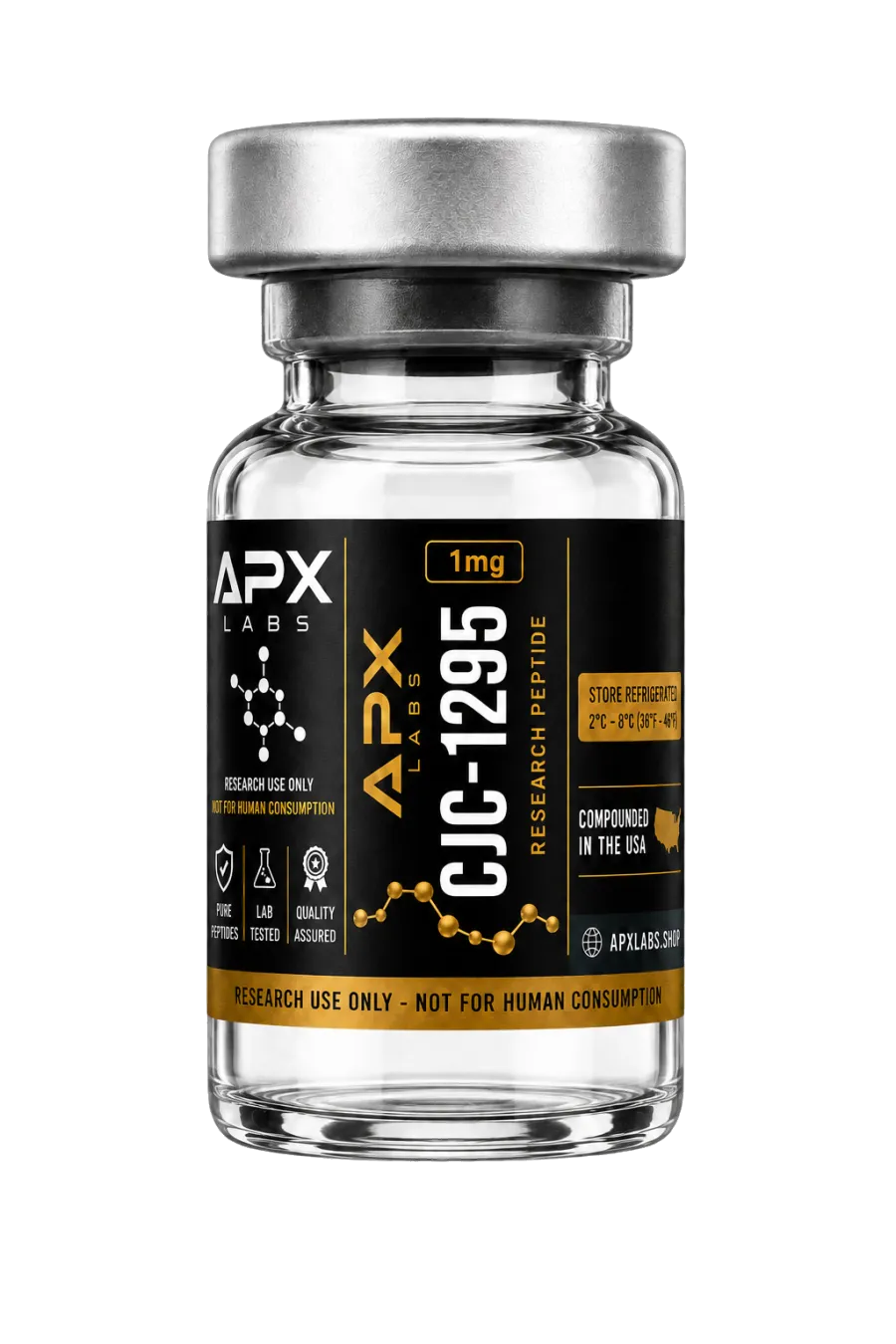
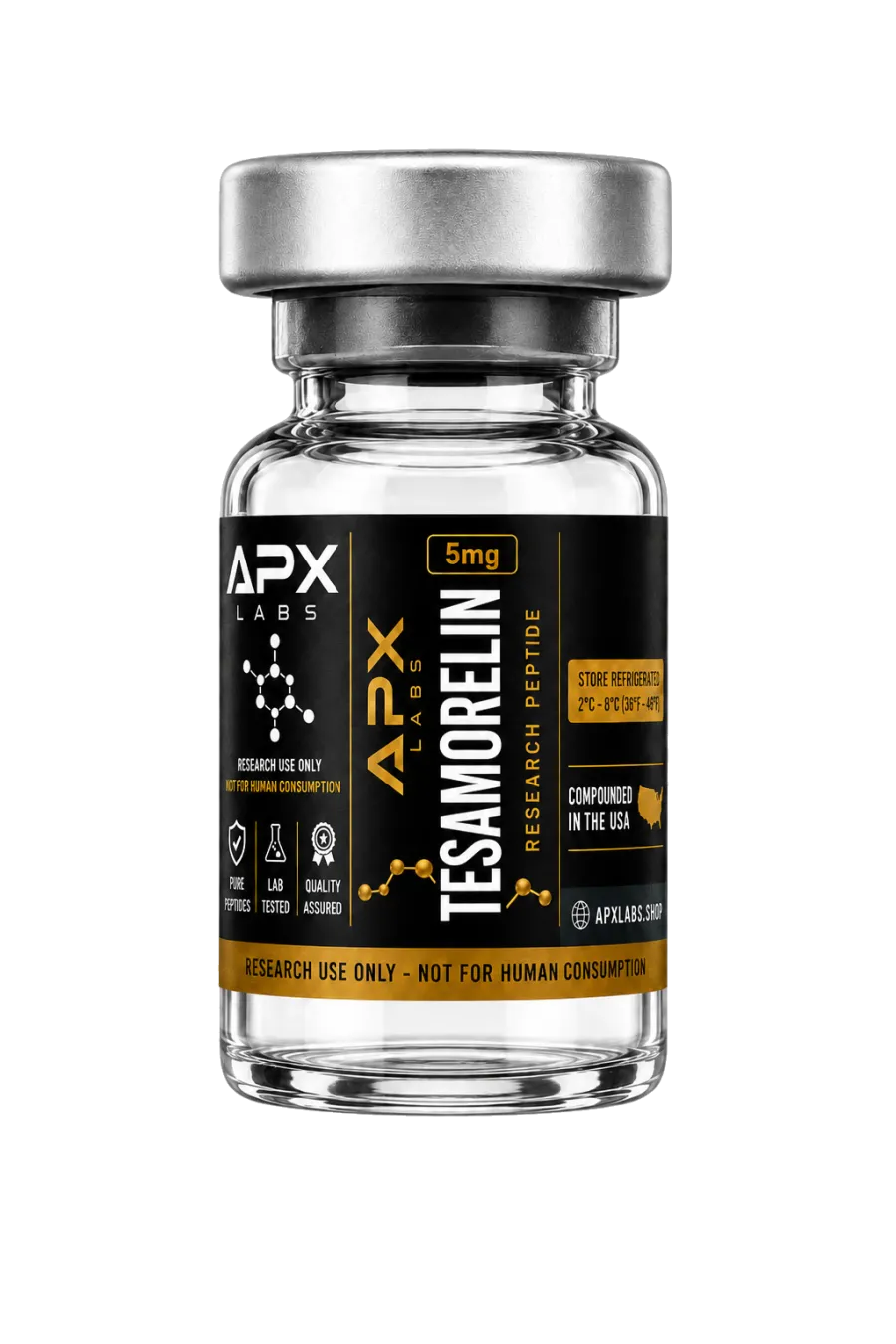
GHRH is a 44-amino-acid hypothalamic hormone cleaved by DPP-IV within minutes. Tesamorelin keeps the full sequence and caps the N-terminus with trans-3-hexenoic acid; CJC-1295 keeps only residues 1–29 and makes four stabilising substitutions (optionally adding an albumin-binding DAC group). Tesamorelin has the larger clinical literature; CJC-1295's two 2006 J Clin Endocrinol Metab papers are its defining references.
What GHRH does
Growth-hormone-releasing hormone is released by the hypothalamus and acts on the pituitary to trigger growth-hormone secretion, which in turn drives IGF-1 production in the liver. Native GHRH(1-44) is cleaved between residues 2 and 3 by the enzyme DPP-IV, giving it a half-life of minutes. The first 29 residues carry the receptor activity, which is why many analogs are 1-29 fragments.
Two engineering strategies
Tesamorelin takes the full 44-residue sequence and adds a trans-3-hexenoic acid group to the N-terminus, blocking the DPP-IV cleavage site. Otherwise it is native human GHRH. Because a pharmaceutical formulation was developed for a specific HIV-related indication, it has an extensive clinical literature: visceral adipose tissue and liver enzymes [1], fat quality [2], muscle composition [3], hepatic fibrosis proteomics [4], and use with integrase inhibitors [5].
CJC-1295 takes only residues 1–29 and makes four amino-acid substitutions (at positions 2, 8, 15 and 27) that protect against DPP-IV and other proteases. The original compound also carried a drug-affinity complex (DAC) — a reactive group that binds covalently to serum albumin, extending residence in circulation to days; the variant without it is often called Mod GRF 1-29. The defining references are two 2006 papers: one characterising prolonged GH and IGF-1 stimulation [6], the other reporting that GH secretion stayed pulsatile under continuous stimulation [7].
Research comparison
- Sequence length: 44 · 29
- Stability strategy: N-terminal cap · residue substitutions (+ optional DAC)
- Literature depth: extensive clinical · two pivotal clinical-pharmacology studies
- Studied endpoints: visceral fat, liver markers, muscle composition · GH/IGF-1 secretion profile and pulsatility
- Molecular weight: 5135.9 · 3367.9 g/mol
- Format: tesamorelin 10 mg vial, $99 · CJC-1295 5 mg vial, $50
Which do laboratories choose?
A lab reproducing or extending the clinical literature reaches for tesamorelin because the published work uses it. A lab studying GH-axis pharmacology with a long-acting, albumin-bound stimulus reaches for CJC-1295 with DAC; one wanting a shorter, more pulsatile stimulus reaches for the non-DAC form. The COA states which form a CJC-1295 lot is.
Clinical and laboratory findings described here concern the drug class and pharmaceutical studies, not the research-grade material sold by APX Labs, which is not a drug and is for research use only.
Frequently asked
What is a GHRH analog?⌄
What is CJC-1295 DAC?⌄
Which has more research, CJC-1295 or tesamorelin?⌄
References
Published research cited for context only. Citing a study does not imply APX Labs product was used in it, and is not a claim of any effect.
- Stanley TL, et al. (2017). Visceral fat reduction with tesamorelin is associated with improved liver enzymes in HIV. AIDS. PubMed ↗
- Fourman LT, et al. (2021). Tesamorelin improves fat quality independent of changes in fat quantity. AIDS. PubMed ↗
- Adrian S, et al. (2019). The Growth Hormone Releasing Hormone Analogue, Tesamorelin, Decreases Muscle Fat and Increases Muscle Area. J Frailty Aging. PubMed ↗
- Fourman LT, et al. (2023). Proteomic Analysis of Hepatic Fibrosis in Human Immunodeficiency Virus-Associated Nonalcoholic Fatty Liver Disease. J Infect Dis. PubMed ↗
- Lake JE, et al. (2024). Efficacy and safety of tesamorelin in people with HIV on integrase inhibitors. AIDS. PubMed ↗
- Teichman SL, et al. (2006). Prolonged stimulation of growth hormone (GH) and insulin-like growth factor I secretion by CJC-1295. J Clin Endocrinol Metab. PubMed ↗
- Ionescu M, Frohman LA (2006). Pulsatile secretion of growth hormone (GH) persists during continuous stimulation by CJC-1295. J Clin Endocrinol Metab. PubMed ↗
Compounds mentioned
Keep reading
- How to Read a Peptide Certificate of Analysis (COA)Every APX Labs order ships with a batch-specific COA. This is how to read it — and how to tell a real one from a decorative one.
- How to Reconstitute Lyophilized Peptides for Laboratory UseLyophilized peptides arrive as a dry cake in a sealed vial. Turning that into a solution of known concentration is simple, but the details protect the material.
- What HPLC/MS Purity Testing Actually MeasuresTwo techniques, two questions. HPLC asks how much; mass spectrometry asks what. A COA that answers only one is half a COA.
Ready to start your research?
Third-party tested. COA-backed. Shipped discreetly. For research use only.