
What HPLC/MS Purity Testing Actually Measures
Two techniques, two questions. HPLC asks how much; mass spectrometry asks what. A COA that answers only one is half a COA.
Published 2026-09-18 · APX Labs Research Desk · For laboratory research context only — not medical advice.
HPLC separates a sample into components and reports purity as the main peak's share of total peak area. Mass spectrometry measures the main component's molecular mass and confirms it matches the expected peptide. Purity without identity can certify the wrong molecule; identity without purity says nothing about impurities. APX Labs runs both on every lot at an independent laboratory.
HPLC — how much
High-performance liquid chromatography dissolves the sample and pumps it under pressure through a column packed with fine particles. For peptides the standard mode is reversed-phase (RP-HPLC): the particles are hydrophobic, so components that are more hydrophobic stick longer and emerge later. A UV detector at the outlet — typically at 214 or 220 nm, where the peptide bond absorbs — records a signal over time. The result is a chromatogram: a baseline with peaks.
The target peptide is the main peak. Impurities from synthesis — deletion sequences missing a residue, truncated chains, incompletely deprotected or oxidised variants — appear as smaller peaks, usually close to the main one. Purity is the main peak's area divided by the total area of all peaks, expressed as a percentage.
What HPLC cannot do is tell you *what* the main peak is. Two different peptides can elute at the same time.
Mass spectrometry — what
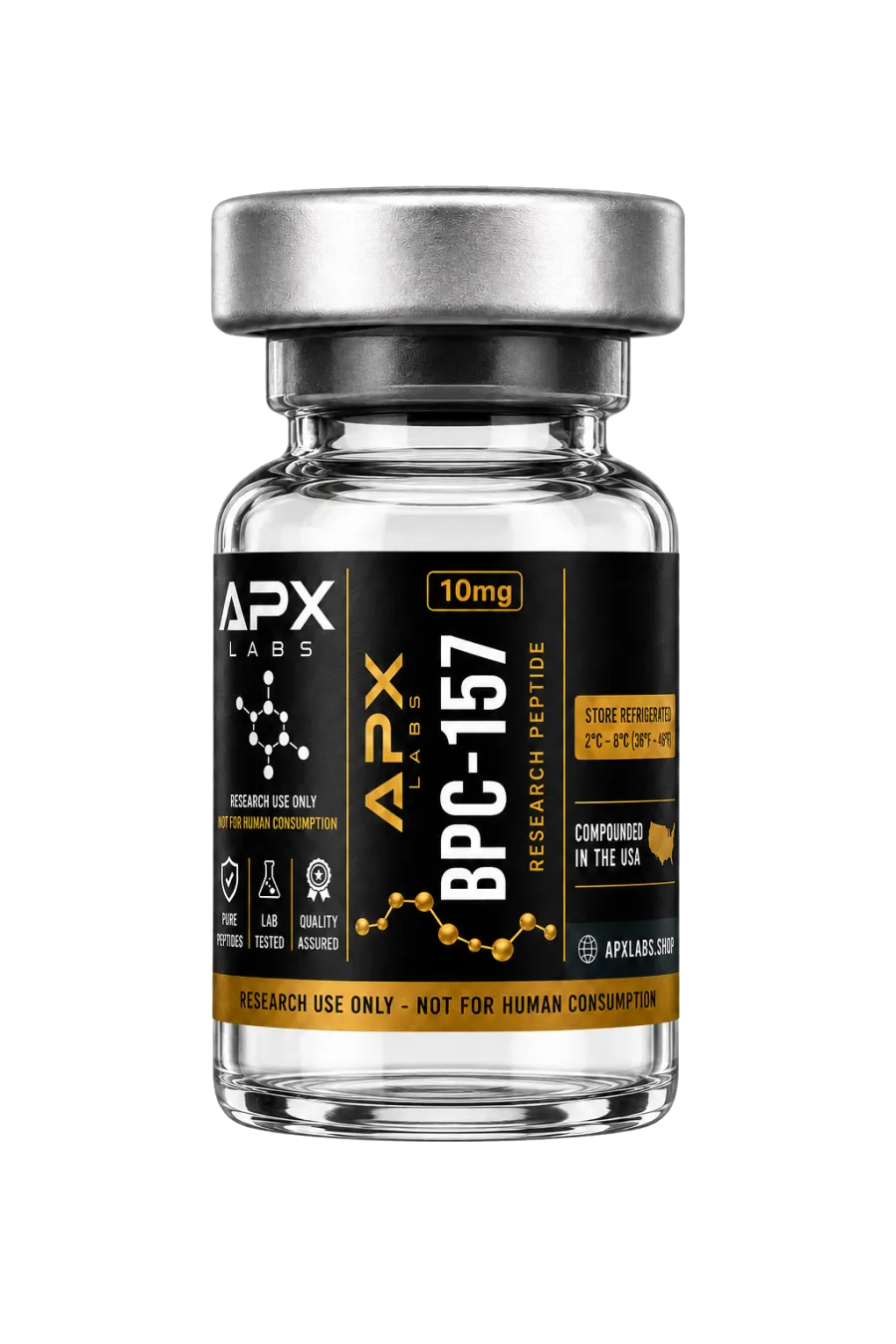
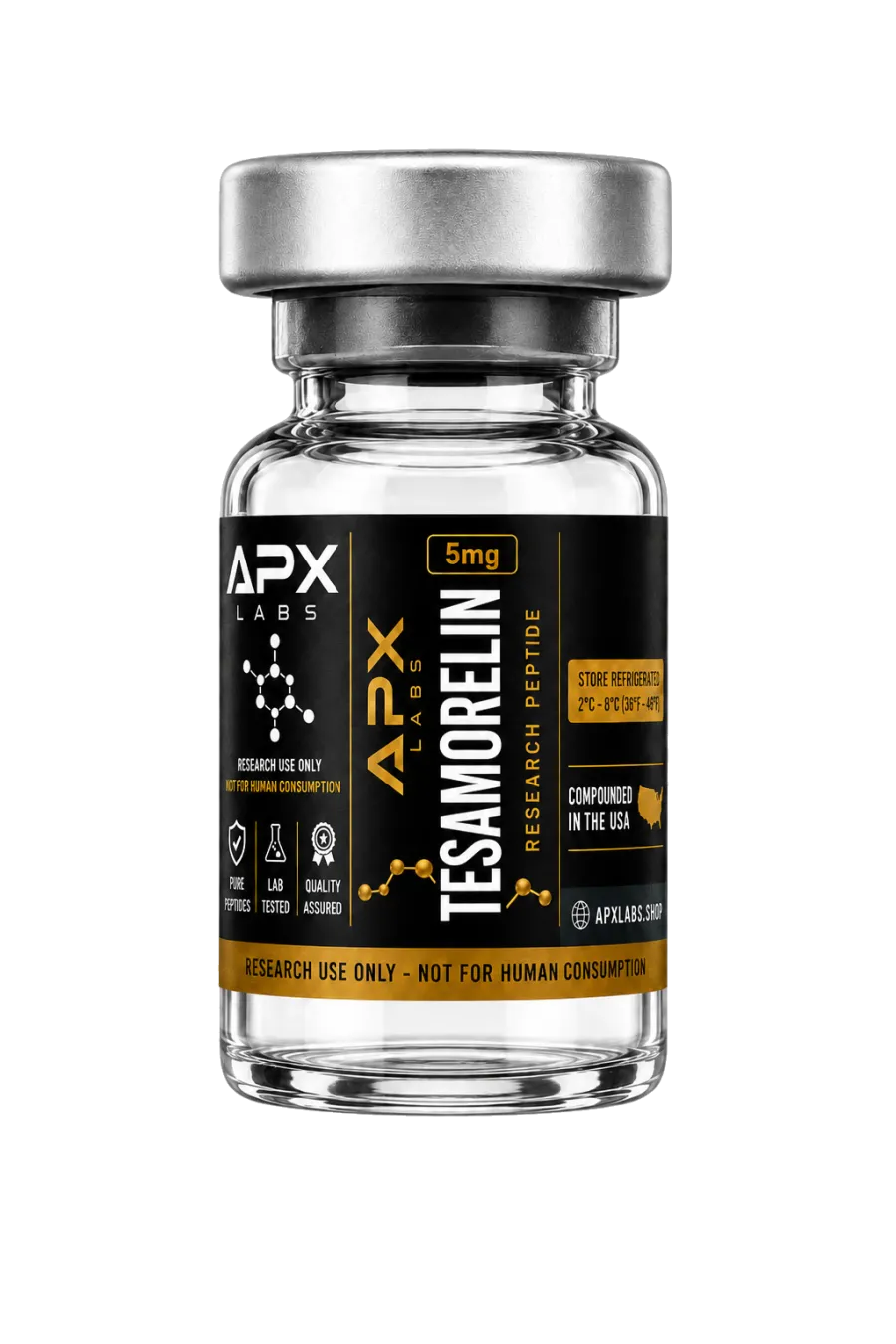
Mass spectrometry ionises the sample and measures the mass-to-charge ratio of the ions. For a peptide the key output is the measured molecular mass of the main component. The COA compares it with the theoretical mass calculated from the expected sequence — 1419.5 g/mol for BPC-157, 5135.9 for tesamorelin — and agreement within instrument tolerance confirms identity. Peptides often appear as multiply-charged ions, so the raw spectrum needs deconvolution; the COA normally reports the deconvoluted mass.
High-resolution MS can go further and quantify co-eluting impurities that HPLC alone would hide inside the main peak [1], and can distinguish impurity profiles between synthesis routes [2].
Why both
- HPLC only: a 99% pure sample of the wrong peptide passes.
- MS only: the right peptide at 80% purity passes.
- Both: the right peptide, and a measured share of it.
That is why a complete peptide COA has an HPLC section and an MS section, and why APX Labs specifies both.
How APX Labs tests
Every lot goes to an independent laboratory for RP-HPLC purity and MS identity before release. The laboratory's report — chromatogram, peak table, purity percentage, observed vs theoretical mass, method conditions, test date, lot number — is the COA that ships in the box. For blended pens each component is reported. The full process is on the testing page; reading the resulting document is covered in how to read a COA.
Analytical testing documents what a sample contains. It says nothing about effects or suitability for any use. APX Labs products are for research use only.
Frequently asked
What does HPLC purity mean?⌄
Why is mass spectrometry needed if HPLC already shows purity?⌄
What wavelength is used for peptide HPLC?⌄
References
Published research cited for context only. Citing a study does not imply APX Labs product was used in it, and is not a claim of any effect.
- Kodidasu A, Acharyya K, Ramu VG (2025). Absolute Quantitation of Coeluting Impurities in Peptide Drugs Using High Resolution Mass Spectrometry. J Am Soc Mass Spectrom. PubMed ↗
- Wu P, Cheng Y, Li D et al. (2026). Comparison of Structurally Related Impurity Profiles in Teriparatide From Synthetic and Recombinant Sources. Rapid Commun Mass Spectrom. PubMed ↗
Compounds mentioned
Keep reading
- BPC-157 vs TB-500: What the Research Actually ComparesThe two most-requested recovery-category peptides are structurally unrelated and studied through different pathways. Here is the side-by-side, with sources.
- How to Read a Peptide Certificate of Analysis (COA)Every APX Labs order ships with a batch-specific COA. This is how to read it — and how to tell a real one from a decorative one.
- How to Reconstitute Lyophilized Peptides for Laboratory UseLyophilized peptides arrive as a dry cake in a sealed vial. Turning that into a solution of known concentration is simple, but the details protect the material.
Ready to start your research?
Third-party tested. COA-backed. Shipped discreetly. For research use only.